
With CES 2026 still underway, televisions and display systems are reaffirming their place as a centerpiece of the show. Even as AI defines the overarching narrative, display technology continues to be the clearest reflection of how those advances translate into real-world products, combining hardware innovation with increasingly sophisticated processing.
What is becoming evident is a shift in priorities across the TV industry. Progress is no longer measured primarily by higher resolutions, but by more accurate colour reproduction, refined form factors, and intelligent systems that adapt visuals in real time.
Samsung’s 130-Inch Micro RGB TV: Pushing Display Boundaries
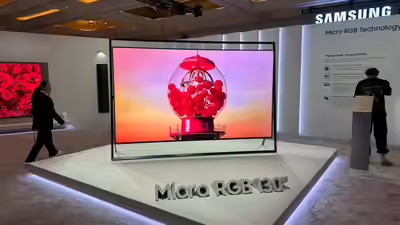
Among the most talked-about reveals so far is Samsung’s 130-inch Micro RGB TV, a display that signals where ultra-large premium screens are headed.
Unlike traditional LED or OLED panels, Micro RGB technology uses microscopic red, green, and blue LEDs as individual light sources. This approach allows for:
-
Exceptionally precise colour reproduction
-
Higher peak brightness without compromising contrast
-
Greater control over individual pixels compared to conventional LED systems
The sheer scale of the display positions it firmly in the ultra-premium segment, but its significance goes beyond size. Samsung is using CES 2026 to demonstrate that Micro RGB could represent a long-term alternative to OLED, particularly for very large screens where brightness and longevity become critical.
This reveal reinforces Samsung’s strategy of pushing display innovation at the top end first, before gradually scaling technologies downward over time.
LG’s 9 mm OLED “Wallpaper” TV: Design Meets Engineering
Not to be outdone, LG has drawn attention with its 9-millimeter-thin OLED “Wallpaper” TV, one of the thinnest wireless OLED displays showcased so far at CES 2026.
LG’s approach highlights a different priority: industrial design and spatial integration. By dramatically reducing thickness and minimizing visible cables, the company is positioning the TV as a seamless part of the living space rather than a standalone device.
Alongside this design-focused reveal, LG has also expanded its Micro RGB display lineup, targeting improved colour accuracy and brightness on large-format screens. This dual strategy – ultra-thin OLED for design-conscious consumers and advanced Micro RGB for premium performance – underscores LG’s intent to cover multiple high-end segments simultaneously.
Micro-LED and Mini-LED Momentum Across Brands
Beyond Samsung and LG, multiple manufacturers – including TCL – are using CES 2026 to showcase refinements in micro-LED and mini-LED TV technology.
These displays emphasize:
-
Higher brightness levels suitable for varied lighting conditions
-
Improved contrast through finer local dimming zones
-
Better colour consistency across large panels
Mini-LED, in particular, continues to gain traction as a more accessible path to premium picture quality, sitting between traditional LED and OLED in both performance and price. The presence of multiple brands pushing similar technologies suggests that mini-LED is becoming a mainstream premium standard, rather than a niche alternative.
Why TV Tech Still Matters at CES
Despite the rapid rise of AI software and services, televisions remain one of CES’s most important categories for a reason. TVs are:
-
A convergence point for display innovation, AI processing, and smart ecosystems
-
A consumer-facing showcase for technologies that later filter into monitors, automotive displays, and commercial signage
At CES 2026, improvements in form factor, colour fidelity, brightness control, and intelligent upscaling are tightly linked to AI-driven image processing. Modern TVs are increasingly defined not just by their panels, but by how effectively onboard AI can optimize content in real time.
What This Signals Going Forward
As CES 2026 unfolds, one thing is already clear: the future of TV is not incremental – it is architectural. Manufacturers are rethinking how displays are built, how they integrate into living spaces, and how intelligence enhances viewing without user intervention.
Over the next 12–24 months, expect:
-
Greater adoption of Micro RGB, micro-LED, and mini-LED technologies
-
Continued pressure on OLED to differentiate through design and efficiency
-
AI-driven picture optimization becoming a baseline expectation, not a premium feature
TV technology remains a marquee category at CES because it reflects where consumer electronics is heading overall: bigger, smarter, more integrated, and more invisible in everyday life.