
When it comes to choosing a computer, whether it’s for work, study, or entertainment, one of the crucial decisions you’ll face is selecting between integrated and dedicated graphics. This choice can significantly impact your device’s performance, especially in tasks that require high graphical output, such as video editing, gaming, and 3D modeling. With technology advancing rapidly, the gap between integrated and dedicated graphics continues to narrow, making the decision in 2026 more challenging than ever. In this article, we’ll delve into a real-world test comparing these two types of graphics processors, providing insights to help beginners, students, remote workers, and small business users make an informed decision.
Understanding the Basics
TL;DR: When it comes to choosing a computer, whether it’s for work, study, or entertainment, one of the crucial decisions you’ll face is selecting between integrated and dedicated graphics. This choice can significantly impa…
Table of Contents
Before diving into our real-world test, it’s important to understand the basic differences between integrated and dedicated graphics:
- Integrated Graphics are built into the CPU (Central Processing Unit) and share memory with the processor. They are cost-effective and energy-efficient, making them suitable for everyday tasks such as web browsing, document editing, and light photo editing.
- Dedicated Graphics, also known as Discrete Graphics, come in the form of a separate card installed in the computer. They have their own memory (VRAM) and are designed for more graphically intensive tasks. These are typically found in gaming laptops, high-end workstations, and PCs designed for video editing and 3D rendering.
Real-World Test Setup
For our 2026 real-world test, we selected a range of applications and games that are widely used by beginners, students, remote workers, and small business users. Our goal was to evaluate how integrated and dedicated graphics perform in everyday scenarios as well as in more demanding tasks. The test included:
- Web browsing and video streaming
- Document editing and spreadsheet management
- Photo editing with Adobe Photoshop
- Video editing with Adobe Premiere Pro
- 3D modeling with Autodesk Maya
- Popular games at medium and high settings
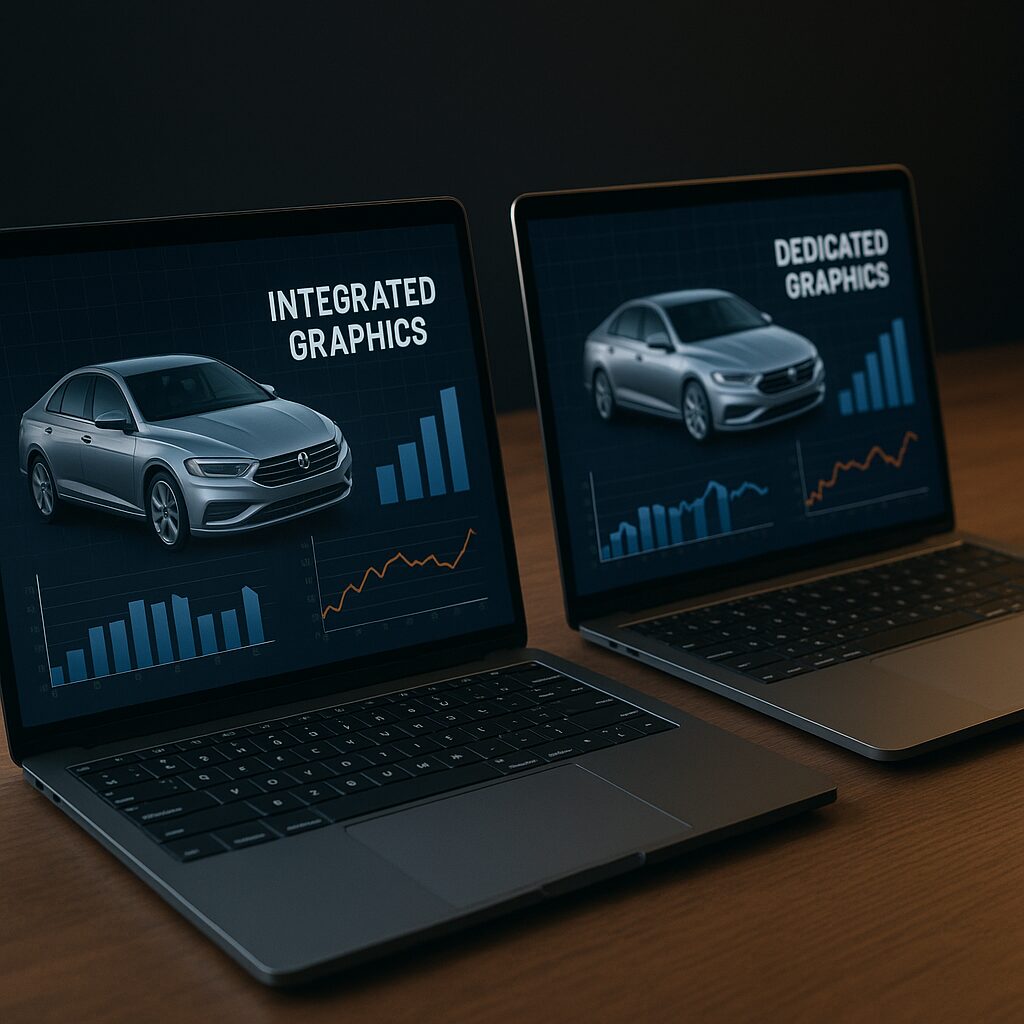
We used identical test systems, varying only in their graphics solutions: one with the latest integrated graphics and the other equipped with a mid-range dedicated graphics card from 2026.
Don’t Miss This: i5 vs i7 for Programming: Is the Upgrade Worth It?
Don’t Miss This
Performance Insights
Everyday Tasks
In tasks such as web browsing, video playback, and document editing, both systems performed admirably with negligible differences. Integrated graphics have come a long way, and for most everyday applications, they are more than sufficient.
Photo and Video Editing
When it came to more demanding tasks like photo and video editing, the differences began to emerge. The system with dedicated graphics showed a notable improvement in Adobe Photoshop and Premiere Pro, handling large files and complex edits more smoothly. Rendering times were also significantly faster on the dedicated system.
3D Modeling and Gaming
The most considerable differences were observed in 3D modeling and gaming. Autodesk Maya worked more efficiently on the system with dedicated graphics, managing complex scenes and simulations with greater ease. Gaming performance also favored dedicated graphics, with higher frame rates and better visual fidelity at medium and high settings.
Energy Consumption and Heat Production
Beyond performance, we also measured energy consumption and heat production. As expected, the integrated graphics system was more energy-efficient and produced less heat under load, making it a better option for those concerned with battery life and system longevity.
Conclusion: Making Your Choice in 2026
The gap between integrated and dedicated graphics has indeed narrowed in 2026, but the choice between them should be influenced by your specific needs:
- If your computer usage is geared towards everyday tasks, with occasional photo and video editing, integrated graphics offer a great balance of performance, energy efficiency, and cost.
- For those involved in more graphically intensive tasks such as professional photo/video editing, 3D modeling, or gaming, a system with dedicated graphics is worth the investment for the performance gains alone.
Ultimately, the decision comes down to understanding your needs and how you plan to use your computer. By considering the insights from our real-world test, you can make an informed choice that best suits your requirements in 2026.
Last Refreshed: March 21, 2026