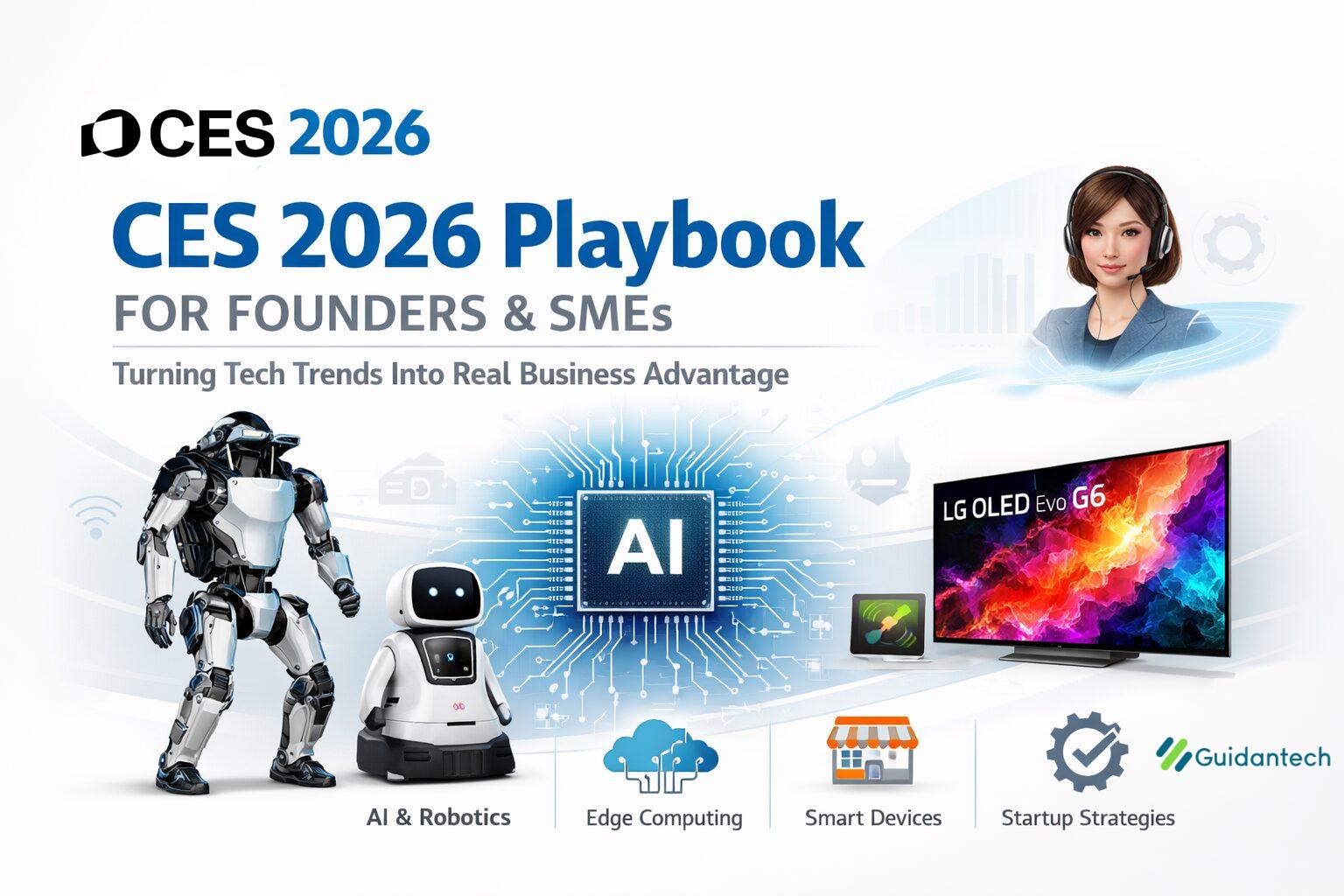
CES 2026 Playbook for Founders & SMEs: How to Turn Tech Trends Into Real Business Advantage

Why CES 2026 Matters for Founders and SMEs
CES 2026 wasn’t just a gadget parade – it revealed the practical frontier of AI-powered business and physical computing. From NVIDIA’s Vera Rubin platform reshaping how AI is built and deployed to consumer and enterprise robotics taking real form, the show made it clear: the next wave of competitive advantage will come from applied intelligence and automation – not just abstract tech demos.
For founders and small-to-medium enterprises (SMEs), this means new opportunities – if you know where to start. This playbook translates CES 2026 trends into immediate business actions that anyone can adopt, regardless of budget size.
1. The Rise of Physical AI: From Cloud to Real-World Action
What Happened
CES attendees saw a shift beyond “AI software” to Physical AI – AI that interacts with the physical world through robotics, edge computing, and task automation hardware. NVIDIA’s Vera Rubin showcased AI performance that can power next-generation robots and autonomous systems.
What It Signals
AI is no longer only about data in the cloud. It’s becoming embedded intelligence that interacts with environments, humans, and objects. This is a powerful trend for businesses that want to automate operations or offer new services.
30–90 Day Playbook
Founders should:
- Explore how AI can automate at least one manual process in your business – not with AI chatbots, but operational AI (e.g., scheduling, robotic workflow triggers).
- Pilot simple edge AI tools (e.g., AI cameras for inventory, sensors for environmental monitoring).
SMEs can:
- Evaluate affordable edge AI platforms (TinyML devices, on-device inference kits) to reduce dependence on cloud costs and latency.
Mistakes to Avoid
- Don’t assume every AI labeled product delivers real automation. Validate by testing data-to-action outcomes.
- Avoid overpaying for enterprise cloud AI when edge or hybrid solutions are sufficient.
2. Advanced AI Computing at Scale – Accessible Innovation
What Happened
NVIDIA’s Vera Rubin platform was one of the most talked-about launches, promising faster, more efficient AI training and deployment, and shaping how models power robotics and other systems.
What It Signals
AI at scale – previously reserved for large enterprises – is becoming operationally attainable through optimized platforms. Even smaller businesses can access more capable AI through partnerships or cloud credits using these newer platforms.
30–90 Day Playbook
Founders should:
- Audit your AI workload needs: what requires high compute versus what can run on lower power.
- Apply for NVIDIA-partner credits or cloud grants to prototype advanced AI functions.
SMEs can:
- Identify one area where accelerated AI yields clear ROI (e.g., customer support automation, demand forecasting) and test with open source tools optimized for Rubin-class architectures.
Mistakes to Avoid
- Don’t overcommit to custom model training before testing simpler alternatives with open or shared models.
3. AI Voice Agents & Assistant Platforms for Productivity
What Happened
Lenovo unveiled Qira, its next-generation AI voice assistant built across devices and designed to learn user behavior over time.
What It Signals
Beyond generic voice assistants, AI agents tailored to workflow contexts (productivity, task management, multi-device integration) are arriving. This accelerates personalization in business tools.
30–90 Day Playbook
Founders should:
- Integrate AI voice or conversational interfaces into your apps or workflows where users perform repetitive tasks (e.g., CRM updates, inventory lookup). Start with no-code/low-code tools.
SMEs can:
- Use AI voice tools on existing hardware (smartphones, tablets) to prototype new internal workflows – e.g., AI meeting summaries, hands-free task logging.
Mistakes to Avoid
- Ignoring privacy policies – ensure AI voice data handling complies with customer and employee expectations.
4. Robotics That Do Real Work
What Happened
Hyundai (via Boston Dynamics) took Atlas, the highly mobile humanoid robot, to the public stage, signaling robotics moving from concept to enterprise-grade use.
Meanwhile, consumer robotics like LG’s CLOiD household robot appeared on the show floor.
What It Signals
General-purpose robotics is growing up. Robots are shifting from novelty to utility – capable of repetitive, predictable tasks in service, logistics, and operations.
30–90 Day Playbook
Founders should:
- Identify operational bottlenecks that robots could perform (inventory sorting, simple assembly, repetitive tasks) and forecast robotics ROI.
SMEs can:
- Partner with local robotics integrators or universities to pilot a modular or simulated solution before large capital spend.
Mistakes to Avoid
- Don’t expect humanoid robots to immediately replace humans – start with assisted automation rather than full replacement.
5. Smarter Home & Retail Tech Drives Consumer Stickiness
What Happened
Companies like LG and Samsung demonstrated AI-enabled consumer electronics that adapt to users and environments – from TVs with context-aware AI to AI laundry and smart appliances.
What It Signals
Intelligence at the edge is proliferating into daily experience – a trend founders can plug into for sticky user experiences in consumer-oriented products.
30–90 Day Playbook
Founders should:
- Think beyond “smart” labels – prioritize products that perceive context (e.g., user state, environment) to deliver actionable outcomes.
SMEs can:
- Use smart tools (AI-enabled cameras, sensors) to upgrade customer experience or optimize operations (energy monitoring, automated service triggers).
Mistakes to Avoid
- Don’t build features that look smart but don’t reduce friction – e.g., adding AI without measurable benefit like reduced support calls.
6. AI in Every Product Category – From Wearables to Health
What Happened
Across the show floor, AI was not a standalone category – it underpinned nearly every product, from pet tech to health wearables and industrial tools.
What It Signals
AI has shifted from being a “special add-on” to an infrastructure layer across product portfolios. For startups, understanding where AI adds real value (not fluff) is crucial.
30–90 Day Playbook
Founders should:
- Map your product/service journey and find one point where AI adds measurable value – not for hype, but for impact.
SMEs can:
- Integrate third-party AI APIs for analytics, automation, or personalization without building from scratch.
Mistakes to Avoid
- Don’t add AI just because competitors do – anchor it in user value.
7. Modular Robotics & Assistive Machines for SMEs
What Happened
Innovation awards highlighted modular and industrial robots designed for real tasks like construction, payload handling, and site inspection.
What It Signals
Innovations aren’t limited to humanoids. Machines optimized for specific business tasks (e.g., elevated work, logistics) are now becoming commercially viable.
30–90 Day Playbook
Founders should:
- Explore modular robotic platforms relevant to your industry: warehouse automation, quality inspection, or delivery workflows.
SMEs can:
- Seek leasing options or shared-use models to trial robotics without heavy upfront costs.
Mistakes to Avoid
- Avoid custom robotics builds before clear, repeatable task definition.
8. New AI-First Compute Architectures for Edge Products
What Happened
Beyond Rubin, CES 2026 showcased MEMS and edge compute advances that make AI cheaper, smaller, and more efficient.
What It Signals
AI capabilities are moving closer to the user/device, reducing latency and dependence on remote servers – ideal for real-time systems.
30–90 Day Playbook
Founders should:
- Evaluate whether on-device AI improves user experience or data privacy compared to cloud solutions.
SMEs can:
- Adopt edge AI devices for real-time analytics in retail, manufacturing, or service delivery.
Mistakes to Avoid
- Don’t conflate on-device processing with better outcomes without validating speed, cost, and privacy benefits.
How to Use This Playbook in 2026 and Beyond
CES 2026 made one thing clear: advantage will belong to those who operationalize technology, not admire it. Founders and SMEs should treat these trends as starting points for experimentation, not final answers.
The goal is not to adopt everything. It is to adopt the right thing, early enough to learn before competitors do.
Action Checklist for Founders & SMEs
- Evaluate one manual workflow to automate with AI in the next 30 days
- Prototype an edge AI use case within 60 days
- Apply for computing credits or partner programs for scalable AI tests
- Define clear ROI metrics before robotics investment
- Audit user experience enhancements using AI – measure before and after
- Explore modular robotics pilots with affordable entry models
- Prioritize privacy and data security in all AI deployments
Credibility Statement:
Every insight in this guide is grounded in verified CES 2026 developments and announcements, including NVIDIA’s Vera Rubin platform, Lenovo Qira AI, advanced robotics showcases from Boston Dynamics and Hyundai, and the broad industry trend toward embedded and physical AI.